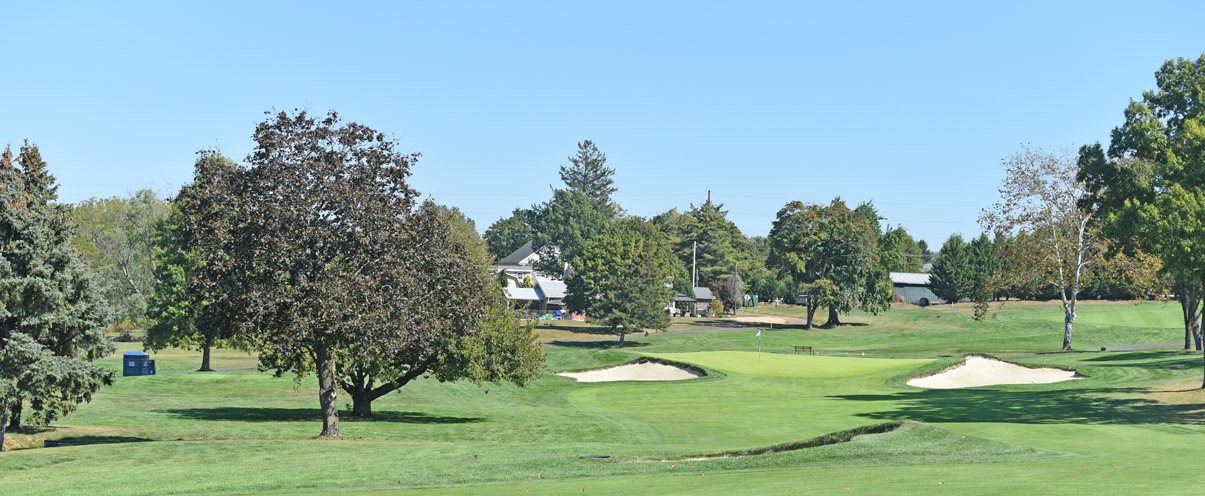
Indian Valley hosts after impromptu meeting
TELFORD, Pa. – John Choyka has always been a man set on giving back and doing the right thing.
When he learned about the Inaugural GAP Adaptive Championship last year, he was bummed. Not because of the event itself, but because he couldn’t help. He was going to be out of town.
| Scoring Portal | Round 1 Recap | Round 1 Video |
An impromptu round of golf enhanced his perspective and changed the course of history. For him and for his beloved Indian Valley Country Club.
“Hosting the Adaptive Championship came into our lap by fate,” Choyka, 75, of Telford, Pa., said. “I happened to play golf with [GAP Manager of Adaptive Golf] Anna Kittelson in GAP’s Family Day event last year at The 1912 Club. I wanted to learn more about the Adaptive Program. I asked her if GAP had any plans for a venue in 2025. I told her how I would love to present the opportunity to our board to host the championship. With David de Garavilla and John Platek being members who would compete in the championship, I thought it would be a great opportunity.”
Indian Valley stepped up to the plate. Its board, members and staff are at the forefront of championing the 2nd GAP Adaptive Championship. No stone left unturned. No support avenue unfulfilled. Numerous members offering their support by volunteering.
“From the start of getting the championship, the board, membership and staff have been fully invested,” Choyka, an Indian Valley member for the past 20 years, said. “As a club we raised close to $30,000 for GAP Adaptive and the GAP Foundation. The rest is history. Indian Valley has always been a longtime supporter of GAP. Hosting this event was a huge deal for us.”
Choyka, an Indian Valley member since 2005, served on GAP’s Executive Committee from 2012-18. He led the club as its president in 2016-17.
“When Jeff Henderson, the Chair of the GAP Adaptive Committee, called me and asked for me to be the tournament chair, I was floored,” Choyka said. “Now that the event is here, I couldn’t be more proud of all of the efforts of all parties involved. Any club who is on the fence about wanting to host this shouldn’t be. It is truly inspiring to see these amazing athletes compete and meeting their families. It brings a tear to your eyes.”

de Garavilla sits second on the overall leaderboard after Round 1. A member for the last four years, he has seen everything Indian Valley represents.
“I think Indian Valley is such a great fit for this tournament and the Adaptive Golf Community,” de Garavilla, a single-leg amputee, said. “There is just as nice feel with the members wanting to celebrate the players a little more. We have two adaptive golfers playing, including myself, from Indian Valley so the club is familiar with the Adaptive community.”
On Saturday, the club hosted an Adaptive Golf Clinic, which helped veterans and adaptive athletes in Telford and its surrounding communities learn the game of golf.
“As a club, our membership is committed to all of the amenities of a country club,” Indian Valley General Manager Eric Beck said. “But at our core, we are a golf club, and golf is a huge passion of everyone who is a member here and works here. To have an opportunity to give back to the community and have the tournament here was something we were ecstatic about.”
Beck, who has been the General Manager for 10 years, said it’s not just about the golf to Indian Valley. Hosting the GAP Adaptive Championship means so much more to the club and its staff.
“I think many of us have been through struggles in our lives,” Beck, 49, of Newtown Square, Pa., said. “We are judged for how we respond to those struggles rather than what some of our worst moments are. I know that is true for me and for the competitors. They have overcome so much just to play in a golf championship. It is so inspiring. As a club we want to be a part of the reason these athletes can succeed and have an opportunity to compete.”
Gomez’s Foundation Provides Prosthetics to Colombia Youth
It was a passing conversation that drove Adolfo Gomez to an internet query about the world of competitive Adaptive Golf. A subsequent trip to Houston, Texas in 2023 for some lessons to better his game and a link up with Jeff Dawley of the North American One-Armed Golfer Association (NAOAGA) changed his life forever.
Dawley overcame a horrific car accident and sustained extreme nerve damage to where he no longer has use of his left arm. Inspired by Dawley, Gomez and wife Monica created the Fundación Mochamp (Foundation Mochamp), a non-profit providing 3D-printed prosthetics to children with upper-limb amputations, in Bogota, Colombia.
“I’m a lawyer. I work in human rights. I defend citizens against the health system,” said Gomez, 40, Bogota, Colombia. “I was helping a lot of people, but it wasn’t my population. When I came to play here in the United States three years ago, I saw a lot of kids using prosthetics to play golf. We don’t have prosthetics in Colombia that are affordable for people. To have a prosthetic in Colombia, you need to have a medical order and then if you don’t have insurance, you don’t get it.
“So what I do with my friends and family is to raise money to print 3D upper limb prosthetics.”
Gomez said his group has fitted 11 children for prosthetic arms. Each custom prosthesis cost approximately $800. The goal is to fit one child a month.
Gomez, who was born without a left hand, said his parents didn’t view his condition as a disability. He competed in many sports growing up, including golf. There was never a limitation. Never a ‘You can’t do.’ It’s the same approach his Foundation takes.
His group talks to the parents of the prosthesis every 15 days to check in. There is an expectation.
“We teach the parents to empower the kids to find solutions,” said Gomez. “[As an example], if you cannot tie a shoe, let’s use shoes without laces. We want it so when they grow up they are not stuck on limitations. Are there physical limitations, ‘Yes.’ You need to find a solution.”
Gomez said he and his wife were entrepreneurs before 2023, designing and executing social programs for the government.

He sees events like the GAP Adaptive Championship as a link in a chain to betterment.
“This tournament impacts other adults. Those adults find someone who has a disabled child. So that adult calls that other adult and says maybe golf can help your child. That chain impacts the life of someone when they grow up. And if that work can positively change one person’s life, I think we came to the world with a purpose,” said Gomez. “I can die. My job’s done. But as God is keeping me alive, I keep working for the other kids.”
Gomez played golf one-handed before this year. Now he has a prosthetic attachment that wraps around his lower arm and the club clips into. It’s basically akin to a microphone stand.
He is still getting accustomed to the new gear. This was his second tournament. He carded a 96.
“Life circles back. I never wanted a prosthetic. I found kids that needed them. And now a kid with a father found me and gave me a prosthetic,” said Gomez. “It changed my life. Golf is a new challenge.”
GAP Adaptive
In 2024, GAP (Golf Association of Philadelphia) launched GAP Adaptive to continue its mission of promoting, preserving and protecting the game of golf for all. GAP’s Adaptive Golf committee opened the season with its first program titled No Limit Clinics, a season-long series of instructional Adaptive Golf events taking place at various GAP Member Clubs. The GAP Adaptive season culminates with the GAP Adaptive Championship, a WR4GD-counting event. The field consists of local and international Adaptive Golfers.
Share This